Growing Automation & Controls
INKBIRD C216T
Growing-condition measurement or control
Sensors and controllers measure or act on devices through supported interfaces.
Current per recorded source Version unknown
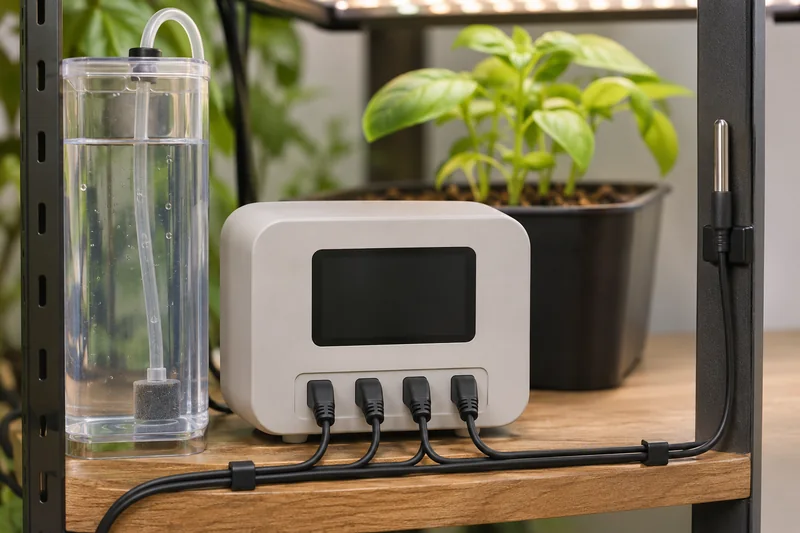
Key specifications
- Sensors and measured quantities
- Temperature
- Controlled equipment
- Heating and cooling equipment
- Calibration
- Calibration adjustment supported
- Brand
- INKBIRD
- Model
- C216T
- Generation / revision
- Unknown
- Regional version
- Unknown; confirm exact plug, voltage and SKU
- Classification
- Growing Automation & Controls
- Technical route
- Growing-condition measurement or control (editorial classification)
- Product status
- current — Published official catalog record; at least one variant available=true. This is not a stock or delivery guarantee.
- Verified
- 2026-11-25
Technical parameters and evidence
Unknown means unverified. The source column distinguishes manufacturer declarations from other evidence. Conflicting values remain in the source record.
| Parameter | Value | Evidence and date |
|---|---|---|
| Physical interfaces | Unknown | No verified value |
| Communications protocol | Unknown | No verified value |
| Sensors and measured quantities | Temperature | Temperature Controller C216T manufacturer declaration · 2026-11-25 catalog description |
| Controlled equipment | Heating and cooling equipment | Temperature Controller C216T manufacturer declaration · 2026-11-25 catalog description |
| Calibration | Calibration adjustment supported | Temperature Controller C216T manufacturer declaration · 2026-11-25 catalog description |
| Compatibility conditions | Unknown | No verified value |
| Power supply | Unknown | No verified value |
| Device ports | Unknown | No verified value |
Configuration and compatibility
- Plug Type: US; EU; UK; AU — options.Plug Type
A shared three-mode design in the lower load class
INKBIRD lists temperature control, recurring on/off cycles and countdown operation on both the C216T and C226T. In temperature mode the household can assess one appropriate heating or cooling appliance. A timed cycle uses elapsed time rather than the measured temperature as its decision signal. The manufacturer documents an IP67 probe for both. That probe rating does not cover the outlet body or make the two probes interchangeable.
The C216T source lists a maximum of 10 A and cites 1,200 W at 120 VAC. That is the clearest documented distinction from the C226T, whose outlet figures differ. Treat the published figures as nameplate limits in the cited market context. Match the regional plug, outlet, connected equipment instructions and load type. A compressor or other motor can have a starting load that cannot be inferred from its usual running wattage.
For a plant-propagation station, write down whether the request is to keep the air within a temperature band or run a load for repeating intervals. The former requires a representative probe position and an appropriate temperature mode. The latter needs a defined cycle and no claim that the schedule measures the temperature. Test the chosen mode on the exact appliance before unattended use and follow both manufacturers’ instructions for the load.
Consider the C216T when one compatible load and the documented lower envelope already meet the job. If the design needs separately controlled heating and cooling outputs, compare an explicitly dual-output controller rather than assuming a mode label creates another outlet. Probe replacement interchangeability and independent verification of control accuracy remain unconfirmed.
Compare the documented setup with INKBIRD C226T or INKBIRD ITC-308.
Use the smaller documented output when the job fits it
The 120 V comparison starts with the manufacturer’s 1,200 W listing for the C216T and the actual load’s specifications, not a promise that any device below that number works. Inspect starting load, regional receptacle and the equipment manual. The C226T offers a higher published rating but does not establish different control modes or a different probe technology. Document the chosen mode, alarm check and recovery behavior for the appliance you would connect.
| Controller | Published rating | Source |
|---|---|---|
| C216T | 1,200 W at 120 VAC; 2,200 W at 220 VAC; listed maximum 10 A | C216T specifications |
| C226T | 1,800 W at 120 VAC; 3,680 W at 230 VAC; listed maximum 16 A | C226T specifications |
Use the rating shown for the exact plug and supply. Both source pages list the same three operating modes and an IP67 probe. Probe interchangeability, load-specific starting limits and whole-device water resistance are unverified. Checked November 27, 2026.
Additional manufacturer evidence
- INKBIRD C216T operating modes and electrical specifications — Manufacturer Specification. Main Features and Specifications. Three modes, IP67 probe, stated maximum 10 A and 1,200 W at 120 VAC. No probe interchangeability confirmation. .
- INKBIRD shared C216T and C226T manual listing — Manufacturer Support. Manual link identifies both model IDs. Numeric ratings in prose use exact product specification pages. .
Known limits
- Manufacturer declarations; no independent testing by GROWVELIA.
- Unknown fields are unverified, not zero.
- Confirm the exact regional SKU and hardware revision with its manual before purchase or connection.
- Regional voltage, plug, relay load and Wi-Fi options must be checked; series options are not separate model counts.
Official sources
- Temperature Controller C216T — manufacturer product data; verified 2026-11-25
Sources document the exact model and test conditions where available.
Conflicts and missing information
No conflict recorded in the reviewed evidence; this is not proof that all sources agree.
Missing technical fields: Physical interfaces, Communications protocol, Compatibility conditions, Power supply, Device ports. Missing identity fields: version, region.
How to read evidence coverage
Coverage describes the record, independent of product performance. Not Applicable fields are excluded from the denominator.
- Documented
- A source records the value.
- Not Provided
- An applicable field has no value in the record.
- Not Applicable
- The field is outside the applicable scope.
- Conflicting Data
- Sources disagree and the value is withheld from dependent decisions.
- Unknown
- The value, revision or market status could not be established.